Getting Amazon ads profitable is almost impossible if you misread your core metrics. The debate around Amazon ACOS vs TACOS vs ROAS is not just terminology; it decides which products you scale, which you cut, and how much you can afford to bid without destroying margin.
This guide breaks down each metric in plain language, shows how they connect, and explains when to prioritize one over another. By the end, you will know exactly how to use Amazon ACOS vs TACOS vs ROAS to diagnose campaign performance and make smarter, data-backed decisions.
Why Amazon ACOS vs TACOS vs ROAS Matters for Profit
Most sellers glance at Amazon advertising performance metrics and only react when spend spikes or sales crash. That reactive approach hides the real questions: are you buying growth, buying profit, or buying vanity revenue that quietly erodes margin?
When you compare Amazon ACOS vs TACOS vs ROAS correctly, you can see which products depend on ads to sell, which benefit from strong organic rankings, and where you are overspending to chase low-quality traffic. This clarity lets you shift budget into campaigns that actually grow your bottom line.
Core Definitions: What Each Metric Really Means
Before you can optimize Amazon PPC metrics, you need precise, working definitions rather than vague rules of thumb. Each metric looks similar on the surface, but the implications for strategy are very different.
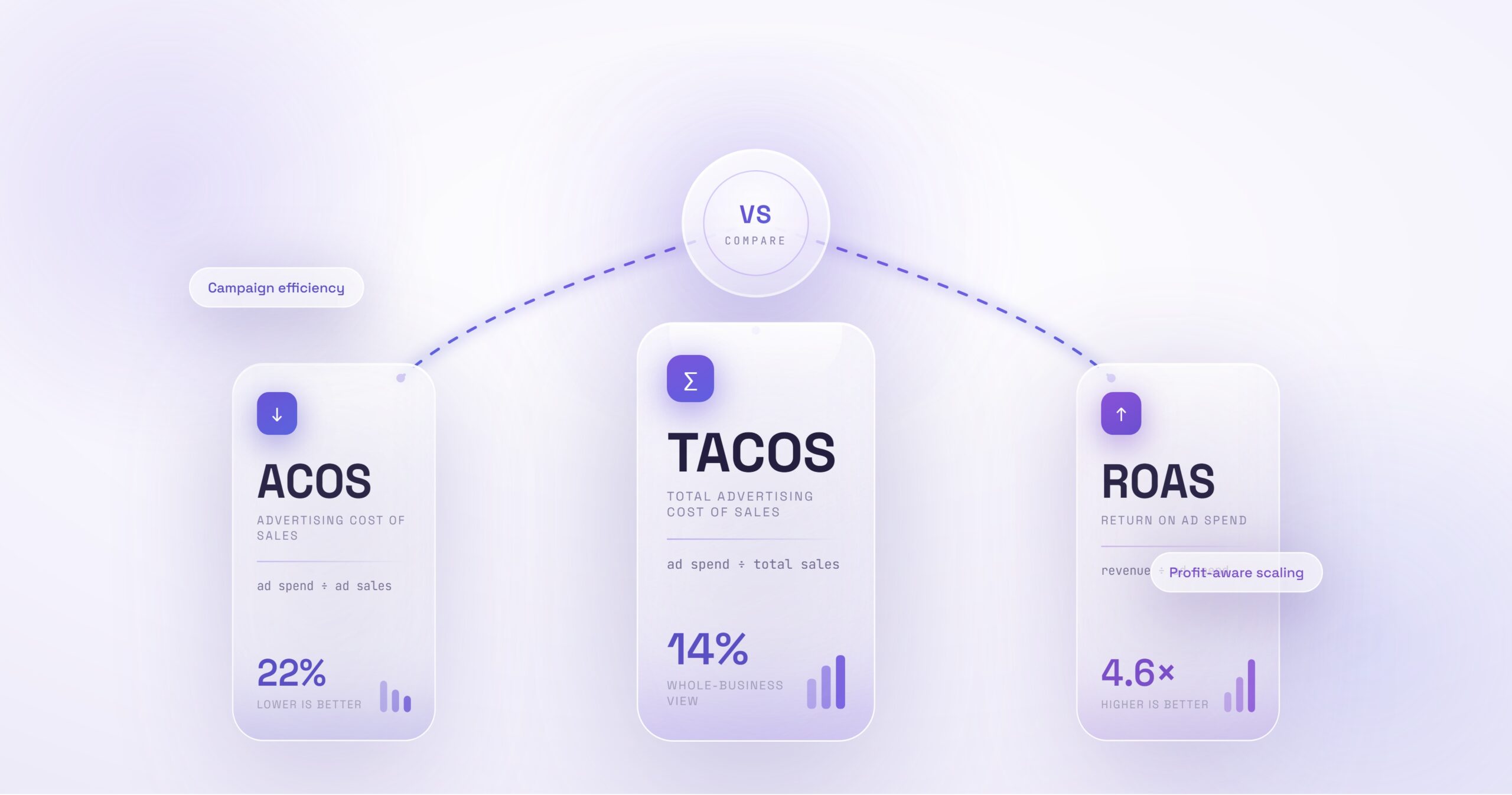
Think of them as three lenses on the same ad spend: ACOS shows efficiency inside the ad console, TACOS shows impact on the entire listing, and ROAS shows revenue per advertising dollar in a more familiar business language.
What is ACOS in Amazon PPC?
ACOS stands for Advertising Cost of Sales. It tells you what percentage of your ad-attributed revenue is spent on ads. A tight grasp on Amazon ACOS helps you quickly judge if a campaign is profitable before considering indirect effects like ranking and repeat purchases.
The formula is simple: ACOS = Ad Spend ÷ Ad Revenue. Lower ACOS generally signals higher efficiency, but context matters. A temporarily higher ACOS can be acceptable for product launches where visibility and review momentum are strategic goals.
What is TACOS in Amazon Advertising?
TACOS stands for Total Advertising Cost of Sales and measures ad spend against total revenue for a product, including both paid and organic sales. When you monitor Amazon TACOS over time, you see whether ads are lifting organic performance or simply replacing it.
The formula: TACOS = Ad Spend ÷ Total Revenue. A falling TACOS combined with steady or rising revenue usually indicates your advertising is supporting ranking gains and brand strength instead of just buying one-off orders.
Understanding Amazon ROAS
Return on Ad Spend shows how much revenue you receive for every dollar spent on ads. Many brands prefer Amazon ROAS because it aligns with broader ecommerce reporting and board-level dashboards.
The formula is ROAS = Ad Revenue ÷ Ad Spend. Higher ROAS is better, but you must balance it against goals for market share, new product adoption, and long-term customer value.
ACOS vs TACOS: When a “Good” ACOS Hides Problems
At first glance, ACOS vs TACOS looks redundant, but these numbers tell different stories. You can run a campaign with excellent ACOS while TACOS quietly creeps up, showing that ads are cannibalizing what used to be organic sales.
Imagine a product that historically sold well through search without heavy advertising. If you increase bids and ad placements, you may see ACOS improve but TACOS worsen as you pay for conversions that used to come for free. Healthy accounts track both and protect margin by watching the long-term trend, not just the last seven days.
ACOS vs ROAS Amazon: Picking the Right Metric for Your Team
Some teams prefer ACOS vs ROAS Amazon because different stakeholders read performance differently. Performance marketers who live inside the console often think in ACOS, while finance and leadership usually think in ROAS.
If your profit model is based on margin percentages, ACOS maps neatly onto target profit margins. If your dashboards and reporting frameworks center on revenue multiples, then ROAS is more intuitive. Both describe the same reality from opposite directions, so your playbook should standardize one as the primary and translate the other when required.
How to Benchmark and Diagnose Your Amazon ACOS
There is no universal “good” Amazon ACOS, but there are smart ways to set realistic targets. Start with your per-unit profit after fees, cost of goods, and typical discounts, then decide what percentage of that profit you can reinvest into ads to hit your growth goals.
Once you know your breakeven ACOS, create tiers: a profit-focused target, a growth-focused target, and a launch or defense target. Campaigns above the top tier need rapid fixes, campaigns between tiers demand experimentation, and campaigns below your lowest target may allow higher bids to grab more search share.
Interpreting Amazon Advertising Performance Metrics Together
No single metric explains everything. Mature accounts read Amazon advertising performance metrics in context: ACOS, TACOS, ROAS, click-through rate, conversion rate, and average order value all combine to tell the story.
For example, an improving ROAS alongside worsening TACOS may signal that your ads are efficient but your total revenue is dropping. By contrast, a stable TACOS and rising total revenue suggest your paid and organic sales are working together, even if ACOS fluctuates week to week.
Practical Workflow to Apply Amazon ACOS vs TACOS vs ROAS
To turn theory into profit, you need a repeatable weekly workflow built around Amazon ACOS vs TACOS vs ROAS rather than chasing individual keywords. The goal is to protect margin while pulling more revenue through your strongest funnels.
Start with TACOS at the product level to identify listings where total profitability is under threat, then drill into ACOS and ROAS at the campaign and keyword levels. This top-down approach stops you from over-optimizing a single ad group while missing the bigger picture.
- Flag products where TACOS has risen for two consecutive weeks.
- Within those products, isolate campaigns with ACOS above your growth target.
- Reduce bids or pause keywords that spend heavily with poor ROAS.
- Reinvest freed budget into search terms with strong conversion but limited impression share.
As you repeat this cycle, document learnings by product type and season. Over time, patterns will emerge that help you set better targets for ACOS vs TACOS and avoid repeating the same testing mistakes.
Turning Metrics into Strategy and Growth
Metrics alone will not grow your business; the advantage comes from disciplined decisions. When you understand the tradeoffs between Amazon ACOS vs TACOS vs ROAS, you can choose when to be aggressive, when to defend, and when to walk away.
Use ACOS to control near-term efficiency, TACOS to protect total profitability, and ROAS to communicate clear results to stakeholders. If you build your optimization routine around these three pillars, you give your brand room to scale without losing visibility into true performance. To streamline this process and stay on top of every shift in your data, consider centralizing your tracking and analysis with Insta Track Pro so you can act on insights before competitors do.
Leave a Reply