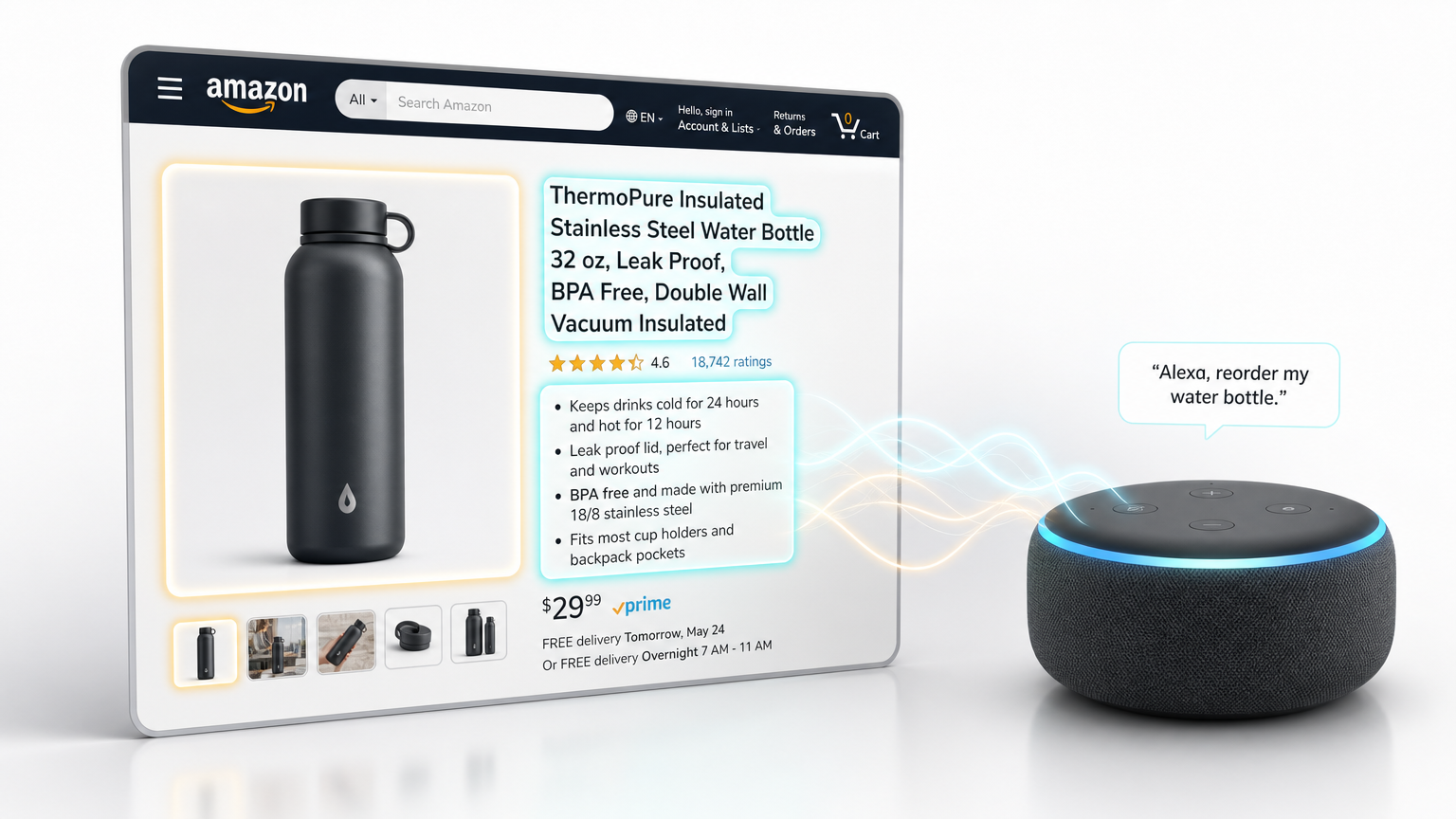
If Amazon listing optimization feels confusing after the Alexa for Shopping and Rufus updates, you are not alone. Many sellers in India are seeing sessions shift from keyword-heavy searches to longer, voice-style queries and have no clear playbook for how to respond.
The good news: the fundamentals of relevance, clarity and conversion still drive ranking. What changes in 2026 is how clearly you feed that information to Amazon’s AI so Alexa can pick your product confidently when a shopper just says, “Alexa, order my usual basmati rice.”
How Amazon AI Search Really Sees Your Listing
Before you rewrite a single bullet, you need to understand how Amazon AI search and Alexa pull data from your listing. AI-first surfaces like Alexa for Shopping rely less on exact keyword matches and more on structured signals: attributes, consistency across fields, and purchase behaviour.
Think of your product page as a data schema, not a brochure. Title, bullets, description, A+ content, and back-end fields all tell Rufus what your product actually is and who it suits. Gaps or contradictions here are why one product is recommended on Alexa and an almost identical one is invisible.
If you are already investing in ads and ACOS management via strategies like those covered in Amazon PPC optimisation guides, that same discipline needs to come to your catalog data.
Structuring Listings For Alexa For Shopping Queries
Alexa for Shopping behaves very differently from a typed search box. Voice requests are natural language, often brand-agnostic, and based on habit: “Alexa, buy kids’ toothpaste under 200 rupees” or “Alexa, repeat my last dog food order”.
This is where Alexa for Shopping optimization starts: mapping your attributes to the way real shoppers speak. For example, if parents usually say “kids” but your variation theme and bullets only say “junior”, your relevance score can slip even if your reviews are solid.
Go through your top sellers and cross-check every field against common voice phrases you hear from customers, reviews, and support tickets. Then build a habit of revisiting that mapping every few months as Amazon updates Alexa surfaces like those described in the Alexa for Shopping Rufus 2026 update.
Amazon Listing Optimization Basics Still Matter
Don’t throw away the basics just because the interface looks smarter. Amazon listing optimization still depends heavily on four blocks: title, key features, images, and back-end keywords. The difference in 2026 is how these feed the AI.
Use your title to clarify the exact product type, core benefit, size, and target user. Use bullets to answer intent-driven questions: for whom, for what problem, under what conditions. Back-end terms can capture alternate ways of saying the same thing, which becomes more important as Rufus parses long questions.
For ad-heavy accounts, align these terms with your keyword research from campaigns structured like those in six-bucket Amazon PPC structures, so organic and paid data reinforce each other.
Preparing For Amazon Rufus 2026 And Beyond
Most sellers in India are still treating Amazon Rufus 2026 as “just a new search layout”. That is a mistake. Rufus is Amazon’s attempt to answer complete questions, not simply rank ASINs. Listings that read like checklists of keywords will lose to listings written as clear answers.
Study the questions Rufus surfaces on your main category pages. Many mirror “People Also Ask” style queries: which size, how often to replace, is this safe for kids, how to store, how long it lasts. The listings that win tend to embed those answers clearly in bullets and descriptions.
Pair this with smart advertising tactics from posts like how AI is changing Amazon advertising so you are not only optimised for organic but also ready when AI-driven ad placements lean on these same data points.
Building Question-Led Content Inside Listings
One of the quickest wins is to rewrite your bullets around buyer questions instead of product features. For example, instead of “High-quality stainless steel construction”, write “Rust-resistant stainless steel body designed for daily kitchen use”. Same keyword, but framed as an answer.
Use the description or A+ modules to handle deeper concerns that Alexa for Shopping and Rufus will pick up, like suitability for certain diets, basic use instructions, or compatibility details that often cause returns.
Technical Hygiene: Attributes, Variations And Data Quality
AI surfaces expose sloppy catalog hygiene faster than traditional search. If your variation themes are misused or your attributes are half-filled, Amazon’s AI has less confidence and is less likely to push your ASIN on voice and conversational surfaces.
Start with a catalog audit. Check that each parent-child relationship truly groups similar products by a legitimate variation theme. Make sure size, colour, flavour, pack count and other key attributes are filled accurately, not fudged to stuff extra words.
Sellers who already use structured thinking for campaign setup from resources like PPC for new product launches often find this kind of data cleanup straightforward because the logic is similar: clean structure equals clean signals.
Back-End Fields And Amazon Product Listing Optimization
Back-end search terms, subject matter, intended use and target audience fields are where a lot of Amazon product listing optimization work quietly pays off for AI discovery. Alexa and Rufus see these even when shoppers do not.
Use these fields to capture regional language variants, misspellings and usage scenarios that would clutter your visible copy. For India, that might mean terms in Hinglish or common shorthand for festival-specific products, but keep it relevant and avoid stuffing unrelated phrases.
Aligning Listings With Amazon SEO Strategy 2026
Listings can’t be optimised in isolation from your Amazon SEO strategy 2026. The AI looks at conversion history, review trends and ad traffic as context. That means your catalog work and campaign work need to talk to each other.
Review your search term reports and identify high-intent phrases that convert well through ads but are missing from the visible listing. Add them naturally into titles or bullets, then watch how organic placements respond for a few weeks.
If you already run structured campaigns on placements like top of search or product pages using ideas from placement-focused PPC strategy, feed the winning phrases back into your core product content.
Connecting Organic Optimization With PPC Data
Many brands keep natural ranking and advertising in separate silos. In an AI-first Amazon world this wastes data. The phrases that drive profitable ads should guide which questions you answer in your bullets and which benefits you highlight in your main image stack.
At the same time, avoid copying every long-tail phrase into your listing. Focus on the themes that match how buyers actually speak to Alexa for Shopping, then use PPC to test more experimental angles on new ASINs.
Practical Workflow For Indian Amazon Sellers
Sellers in India usually do not have a large content team. Often it is one person juggling advertising, catalog, and customer messages. So any workflow for Amazon listing optimization has to be realistic, not a wish list.
A practical quarterly rhythm looks like this: pick your top 20% ASINs by revenue, pull ad and search term data, pull common customer questions, then refresh titles, bullets, and back-end fields to align with latest Alexa for Shopping behaviour. The rest of the catalog follows as time allows.
As you do this, revisit how you are managing ads. Posts such as lowering ACOS without hurting sales velocity or controlling PPC costs in 2026 can help free budget that you then reinvest into content, creative and catalog clean-up.
Conclusion
Voice-led shopping, Rufus-style answers and conversational queries are not a future problem; they are already changing how shoppers in India discover products on Amazon. The brands that treat their catalog as structured data and align it with a clear Amazon listing optimization plan will win the most visibility.
If you want a simpler way to connect your catalog decisions with what is happening in your ads and search performance, solutions from Insta Track Pro can sit alongside your current workflow and highlight where your listings are quietly holding you back.
Frequently Asked Questions
Q1. How do I start Amazon listing optimization for Alexa without a big team?
Ans: Begin with your top 10 to 20 ASINs and clean the basics: accurate titles, clear bullets, strong images and complete attributes. Then update back-end keywords with phrases from your search term reports. Once you see results, apply the same process to the next batch of products.
Q2. What is different about Alexa for Shopping optimization compared to normal Amazon SEO?
Ans: Alexa for Shopping optimisation is more sensitive to natural-language queries and structured data. Typed search can sometimes forgive messy attributes, but voice needs clarity on who the product is for and in which scenario it fits. That means tighter mapping of attributes and more question-focused bullets.
Q3. How will Amazon Rufus 2026 affect my existing product rankings?
Ans: Amazon Rufus 2026 focuses on answering questions, so listings that read like keyword lists may gradually slip for complex queries. You may still rank for basic terms, but lose out when shoppers ask detailed questions that your bullets and descriptions do not address. Regularly updating content around real buyer questions reduces that risk.
Q4. Can Indian Amazon sellers optimise for AI search without heavy software?
Ans: Yes, the core work is still research and editing. Use data you already have: search term reports, customer messages, reviews and basic analytics. Then apply clear rules about how you structure titles, bullets and attributes, making them easier for Amazon AI search to parse.
Q5. How does Amazon product listing optimization work with PPC bids and ACOS targets?
Ans: Strong listings usually improve click-through and conversion, which can support healthier ACOS at the same bid levels. When you update content, watch your PPC metrics for a few weeks before changing bids, so you know how much of the improvement came from listing work versus bid adjustments.
Q6. What should be my Amazon SEO strategy 2026 focus if I sell seasonal products?
Ans: For seasonal items, front-load your work by two to three months: refresh content, attributes and back-end fields before search demand spikes. Incorporate questions shoppers ask around festivals or events and test them with campaigns early so Alexa for Shopping and Rufus have time to learn which listings perform best.
Leave a Reply