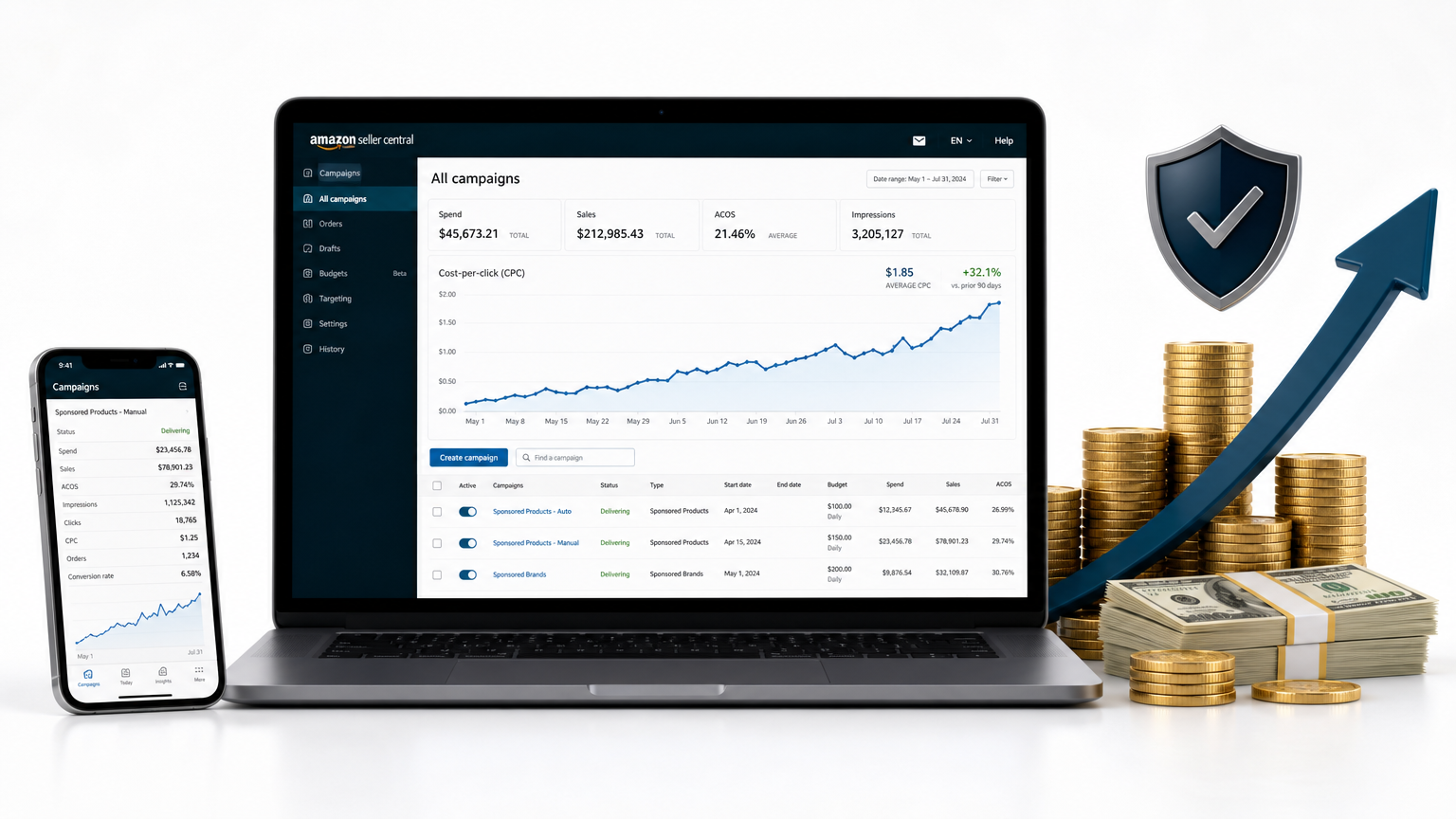
Amazon PPC costs have crept up so much that many Indian sellers now see ad spend eating most of their profit. If you feel like you are paying more every month but not getting more sales, you are not imagining it.
The good news is that rising CPC is not random. Once you understand what is driving it, you can change how you structure campaigns, bids and product pages so your ads stay profitable instead of becoming an endless drain.
Why Amazon PPC Costs Keep Rising In 2026
A few years ago, you could launch Sponsored Products, set a broad keyword at ₹20 and still get cheap clicks. That phase is gone. More sellers in India, higher competition within every niche and aggressive discount-led launches all push the clearing price for each auction upwards.
Amazon CPC is shaped by three main inputs: how many sellers bid on the same shopper query, how relevant your listing is to that query, and how strongly Amazon believes your ad will convert. If sellers keep raising bids without fixing relevance and conversion, the system simply keeps charging more for the same traffic.
How The Amazon Auction Really Works
The Amazon advertising cost you see in your reports is the outcome of a second-price auction running behind every search. You do not pay your own bid; you pay just above the next highest competitor, adjusted for predicted click-through and conversion.
That means two things. First, overbidding only protects you when competitors are close behind, otherwise it just inflates everyone’s CPC. Second, account structure and ad relevance matter as much as money, because a more relevant ad can win the same placement with a lower bid.
Signals That Your CPC Has Become Unsustainable
You do not have to guess when Amazon PPC cost is out of control. The data tells you. A rising cost-per-click combined with flat or falling conversion rate is the clearest warning sign that you are paying more for the same or fewer orders.
Watch three key trends over the past 30 days: search term level CPC, conversion rate per SKU, and average selling price after discounts and coupons. If CPC has climbed but selling price has not, your margin window is shrinking and your ads need urgent surgery.
Linking CPC To Profit Through Amazon ACOS
Ad spend is not the problem on its own; the problem is when ad spend kills profit. Amazon ACOS connects your advertising to revenue by showing what percentage of every rupee you earn is going back to ads.
For example, if your product gives you a 30% margin after Amazon fees and shipping, you cannot run a 40% ACOS for long without burning cash. Track ACOS by campaign, ad group and ASIN, not just at account level, so your winning pockets are not hidden by one bad campaign.
Practical Ways To Reduce Your CPC Without Killing Sales
Stopping ads is rarely the answer. The smarter move is focused Amazon PPC optimization that targets waste first, protects high-intent traffic, and then slowly improves conversion. Think in terms of weekly clean-up tasks rather than one big overhaul.
Start by pulling a 60–90 day search term report and labelling each term as “hero”, “support” or “waste” based on ACOS and conversion. Most Indian sellers find that a handful of search terms bring the bulk of their profitable orders, while a long tail quietly burns money.
Step 1: Tighten Targeting With Negatives
Uncontrolled broad and phrase match is the fastest way to inflate Amazon bid optimization work later. Every irrelevant click raises average CPC without adding orders, and the auction has no idea that a query is bad for you until you act on it.
Build a weekly routine: add low-converting or irrelevant terms as negative keywords at the ad group or campaign level, and move any consistently profitable search terms into exact match campaigns where you can protect budget and placement.
Step 2: Improve Listing Conversion Before Raising Bids
Many sellers try to reduce Amazon PPC costs only by cutting bids. That often backfires because lower placement can crash conversion further. A better path is to improve your product page so more of your existing clicks convert before you touch bids.
Focus on the obvious friction: unclear main image, weak title, missing comparison details and thin reviews. Even a small lift in conversion can allow you to pay a slightly higher CPC while keeping ACOS flat or better.
Step 3: Restructure Campaigns Around Intent
Instead of dumping every keyword into one ad group, split campaigns by intent and margin. For example, one cluster around branded terms, one around generic use-cases, and one around competitor-style searches. This makes Amazon PPC management less chaotic and easier to optimise.
Single-keyword or tight ad groups also help the algorithm understand what each ad is really about, which can improve relevance scores and bring CPC down over time as performance stabilises.
Using Amazon Sponsored Products Strategically
Most sellers run Amazon Sponsored Products as “always on” discovery and then complain that budgets disappear by afternoon. The format is powerful for bottom-of-funnel intent, but only if you are deliberate about placements and bids.
Think about where you are willing to pay more. Top-of-search bids might make sense for a narrow set of hero keywords, while product page placements work better for cross-sell and defensive coverage. Even with a simple setup you can use Sponsored Products to support ranking gains instead of reacting to every CPC spike.
Advanced Amazon Bid Optimization Tactics For India-Based Sellers
Once the basics are under control, you can layer in more precise Amazon bid optimization tuned to your category and seasonality. This is where data and tools matter more than guesswork and gut feel.
Review performance by placement to see if top-of-search justifies its higher CPC, and experiment with placement bid modifiers rather than flat bid increases. Many brands in India also see different performance by day of week, so reducing bids or pausing low-performing slots can stabilise ACOS.
When To Cut Bids And When To Hold
Cutting bids purely because CPC feels high can slow organic momentum on important keywords. Before you reduce bids, check three metrics together: ACOS trend, organic rank movement and click-through rate.
If ACOS is high but organic rank is climbing for a hero keyword, you might choose to hold bids for a limited period and review again, treating it as a ranking investment rather than a permanent cost.
Building A Sustainable Amazon Advertising Strategy
Short-term fixes help, but long-term profit comes from a clear Amazon advertising strategy that links business goals, margin structure and ad tactics. That means deciding which SKUs you are prepared to support heavily and which will only get light coverage or defensive bids.
Document simple rules: maximum acceptable ACOS by product type, when to scale spend, when to cut, and how you will test new keywords. Once these rules are clear, it becomes far easier to train a team member to manage campaigns instead of reacting personally to every daily fluctuation.
Where A Tracking And Optimisation Tool Fits In
Manual spreadsheets and Seller Central reports can work for a small catalogue, but once you are juggling dozens of campaigns, human-only Amazon PPC management becomes guess-heavy and slow. At that point many brands start looking at an automation or analytics layer.
A focused tool like Insta Track Pro can bring your scattered data into one view, so you see spend, sales and ACOS for each keyword and placement without exporting reports every week.
Conclusion
Rising Amazon PPC costs are not going away, but sellers in India who treat ads as a disciplined, data-led channel still find room for profit. When you understand what drives CPC and build habits around targeting, bidding and product page improvement, ads become an investment rather than an unpredictable bill.
With that foundation in place, a tool like Insta Track Pro can help you monitor the numbers that matter, keep your Amazon PPC costs tied to profit, and decide confidently where to spend your next rupee.
Frequently Asked Questions
Q1. Why are my Amazon PPC costs so high all of a sudden?
Ans: Sudden spikes usually come from new competitors bidding on the same terms, auto campaigns picking up broad traffic, or seasonal demand pushing up auction prices. Check your search term report for fresh queries, compare CPC before and after the spike, and pause or convert the worst offenders into negatives.
Q2. What is a good Amazon ACOS for sellers in India?
Ans: A “good” ACOS depends entirely on your product margin, shipping costs and discount strategy. Start by calculating your true net margin per unit and then work backwards to a target ACOS that still leaves profit. Many brands run some campaigns at break-even ACOS to support ranking, while keeping the rest below their profit threshold.
Q3. How can I reduce Amazon CPC without turning off my ads?
Ans: Focus on three levers: tighten targeting with negative keywords, improve listing conversion so more clicks become orders, and move high-intent terms into exact match campaigns. Together these steps reduce wasted spend, which lets you keep visibility while bringing average CPC and ACOS under control.
Q4. Is manual or automated Amazon PPC management better?
Ans: Manual control gives you more nuance, but it can become slow and inconsistent as your account grows. Automation works best when your structure, targets and negatives are already in a good place, so the system is optimising on solid foundations instead of messy data. Many sellers blend both, using rules or tools to handle routine bid changes while they focus on strategy.
Q5. How do I know if my Amazon advertising strategy is working?
Ans: Look beyond clicks and impressions to profit per product, long-term keyword rank trends and repeat order behaviour. If your Amazon PPC costs are stable or improving relative to margin, and your key search terms are holding or gaining rank, your strategy is moving in the right direction. Regular monthly reviews help you catch drift before it becomes expensive.
Q6. Can new Amazon sellers in India run profitable Sponsored Products campaigns?
Ans: Yes, but it usually requires a tighter focus than established brands use. Start with a small set of priority SKUs, limit your Amazon Sponsored Products targeting to a shortlist of highly relevant keywords, and keep a close eye on search term reports. As you learn which terms convert, you can expand slowly instead of burning budget on wide, unfocused reach.
Leave a Reply