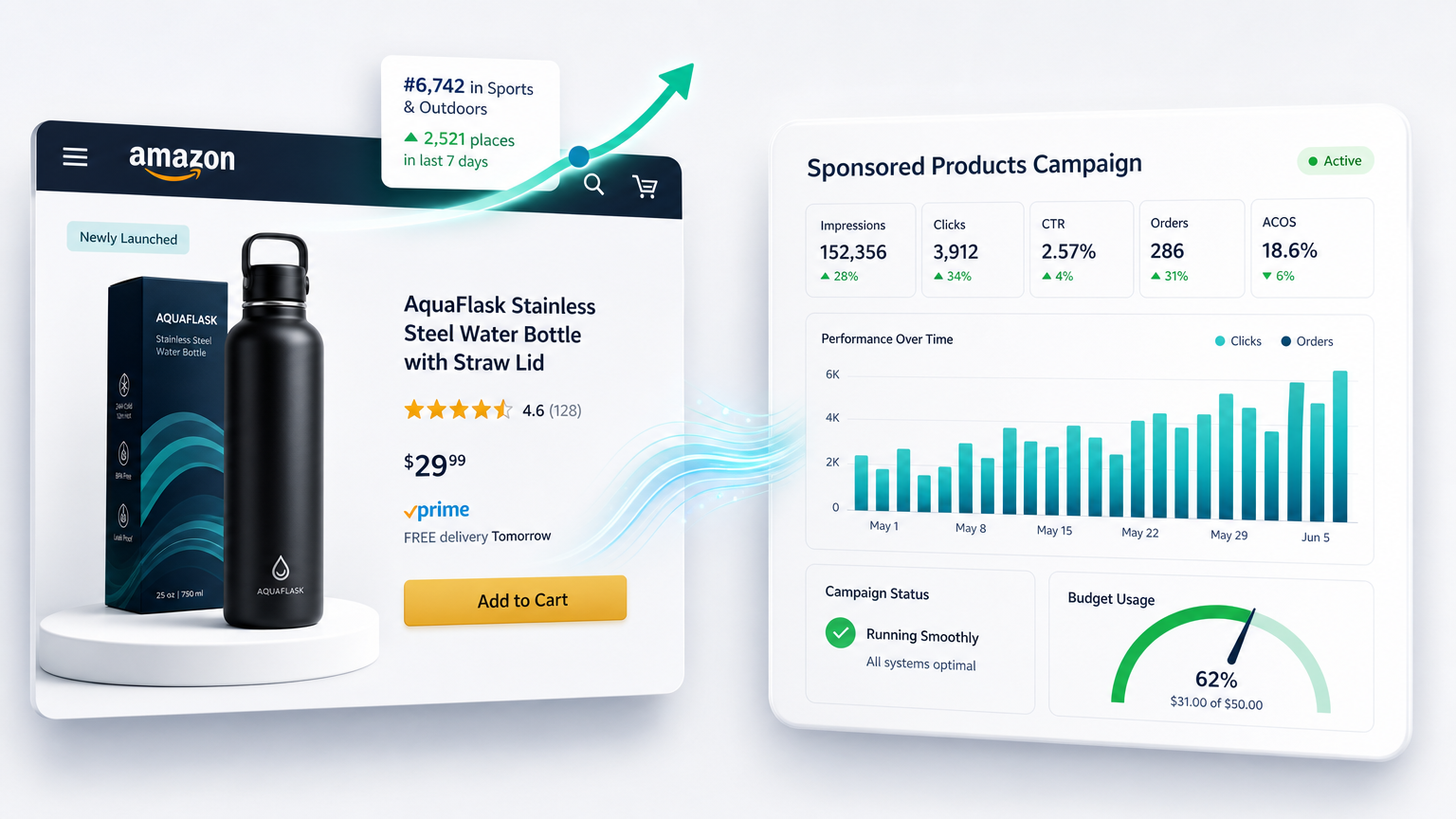
Running Amazon PPC for new product launch campaigns in 2026 is stressful, especially in India where CPCs keep creeping up and competition appears overnight in every category. If you get the launch phase wrong, your ranking, reviews and organic sales suffer for months.
This guide walks through a practical launch framework: how much to spend, how to set Amazon PPC bids in the first 30 days, how to build keyword lists that actually move your product ranking, and how Sponsored Products fits into your broader launch plan.
How Amazon PPC Powers A New Product Launch
Amazon’s algorithm rewards products that convert well and sell consistently, which is why a strong Amazon product launch PPC plan is non-negotiable. PPC gives you the initial visibility that organic ranking can’t provide on day one.
For most small and midsized brands in India, the launch window is 30–60 days. Your goal in that period isn’t profit; it’s controlled sales velocity. Ads bring the traffic, your offer and listing do the rest. Strong PPC signals tell Amazon that your product deserves more impressions at better placements.
During launch, monitor how Sponsored Products traffic behaves across placements. To go deeper on placement strategy once the product stabilises, you can study the detailed breakdown in this guide to top-of-search vs product pages.
Setting A Realistic Amazon PPC Budget For Launch
Your Amazon PPC budget during launch should be higher than what you expect to run in “steady state”. Think of it as launch capital, not a permanent expense line. Too low, and you never exit the “no data, no ranking” loop.
Start by estimating how many daily sales you need to rank on page one for your main keywords. Then ask: how many of those can PPC reasonably drive at a launch ACOS that doesn’t bury you? This gives you a working Amazon PPC budget that aligns with your category’s reality rather than a random percentage of revenue.
As you collect data, compare your actual launch ACOS and TACOS to targets. For a clear explanation of how those metrics behave, keep this ACOS vs TACOS vs ROAS guide handy while you adjust spend during the first few weeks.
Building A Launch-Ready Campaign Structure
A clean Amazon PPC launch strategy starts with structure. You don’t need 20 campaigns on day one, but you do need clear buckets so you can tell what’s working and what’s wasting money.
For a typical launch, think in three workhorse campaigns built around Amazon Sponsored Products:
- Research auto campaign to discover search terms.
- Core manual exact campaign to push priority keywords.
- Broader phrase/broad campaign to catch adjacent demand.
Once the product matures, you can plug it into a more advanced structure like the one described in this 6-bucket campaign framework, but during launch you want focus and fast learning.
Core Keywords Vs Discovery Keywords
Good Amazon keyword targeting separates what you must rank for from what you’re still exploring. Core keywords are high-intent phrases tightly related to your product’s main benefits and features.
Discovery keywords are longer phrases, question-style searches and variations that you’re not yet sure about. These often live in your auto campaign and broader match types first, then graduate into your core campaigns once they show consistent conversions.
Phase-Wise Campaign Rollout
Don’t launch every campaign, ad group and target on day one. In the first week, start with a smaller keyword set and controlled bids. Once you have initial data, add more terms from your search term reports to scale your Amazon launch strategy without blind risk.
This phased rollout also keeps budget from being spread too thin. You’d rather push spend into 10–20 keywords showing signs of life than watch 100 loosely relevant terms chew through ad spend with minimal sales.
Dialling In Amazon PPC Bids During Launch
Launch bids are a balance: high enough to win impressions for priority terms, but not so high that one or two erratic clicks ruin your daily budget. That’s where thoughtful Amazon PPC bids make the difference between controlled testing and chaos.
Start with higher bids on your top 5–10 core keywords and slightly lower bids on discovery terms. Then watch click-through rate, conversion rate and ACOS over the first few days. Pull back quickly on keywords with heavy spend and no sales, and don’t be afraid to double down on a term that’s driving early conversions despite a higher CPC.
Once the product stabilises, you can refine bidding with more detailed approaches like the ones shared in this Amazon bid optimisation formula or newer AI-led bidding strategies.
Using Placement And Time To Protect Budget
Your launch bids don’t have to be the same across every placement. Top-of-search often deserves a premium for your highest-intent keywords, while product pages can be more aggressive later for cross-selling and defence.
Time of day also matters. In India, shopping peaks often line up with office commute windows and late evenings. Once you have intraday data, you can apply concepts from this Amazon PPC dayparting guide to avoid burning budget in weak hours during the launch phase.
Keyword Strategy To Drive Ranking, Not Just Clicks
A launch built only on broad traffic rarely pushes Amazon product ranking to page one. You need a planned mix of branded, generic and competitor-adjacent terms that reflect real buyer journeys.
Start your Amazon keyword targeting with:
- Hero generic terms that describe the core product.
- Benefit-driven phrases that match your differentiation.
- Problem keywords that match the pain your product solves.
- Long-tails that combine use case, material, size or audience.
Use auto campaigns heavily in the first two weeks to mine search terms. Then move proven winners into manual exact campaigns and add negatives to cut wasted spend. For a deeper walkthrough on extracting winners from your auto campaigns, refer to this guide on keyword harvesting for Amazon PPC.
Brand Vs Non-Brand Keywords At Launch
New products typically start with almost no branded searches, so non-brand terms will drive most clicks early on. Still, you should protect your emerging brand traffic as soon as it appears through dedicated branded campaigns.
A clean split between branded and non-branded Amazon PPC campaigns gives you better control on ACOS and budget allocation. Once your brand gains traction, study this detailed guide to branded vs non-branded campaign strategy and adapt it for your scale phase.
Managing Wasted Spend And Optimising During Launch
Even a well-planned Amazon PPC optimization routine will uncover wasted clicks during launch. The sellers who win are not the ones with perfect campaigns on day one, but the ones who respond quickly to bad data.
Make search term review and negative keyword updates a twice-weekly habit in the first month. Cut terms that trigger irrelevant clicks early so more of your budget can feed the best-performing queries.
If you need a deeper playbook on controlling wastage without killing momentum, keep this guide to negative keywords and wasted ad spend alongside your launch checklist.
Watching ACOS Without Killing Momentum
Launch ACOS will usually be higher than your long-term target. The trick is to know how high is acceptable while you build ranking. Instead of slamming the brakes the moment ACOS climbs, segment your data by campaign and keyword first.
Some keywords will be your profit centres later, others are pure visibility plays. A clear understanding of good and bad ACOS ranges, like the approach shared in this good ACOS benchmark guide, helps you avoid panic cuts that stall your launch.
India-Specific Launch Considerations For 2026
Running Amazon PPC for new product launch campaigns in India comes with quirks that global playbooks rarely mention. Demand spikes around local sale events, regional festivals and pay-day cycles can throw off your early data if you don’t account for them.
Plan higher budgets around key events relevant to your category, but ring-fence that spend in separate campaigns where possible. This keeps your always-on campaigns from becoming distorted by short-term peaks, so it’s easier to read post-launch performance.
As advertising costs continue to rise, keeping a close eye on CPC trends and launch-phase bidding is even more important. For broader context on cost pressure and how to adapt your bids, read this analysis of Amazon PPC costs in 2026 and use its insights while planning your launch calendar.
Conclusion
A successful Amazon PPC for new product launch plan in India combines four moving parts: a realistic budget, tight bids on priority keywords, clear campaign structure and fast optimisation based on actual search term data. Get those right and your ranking improves faster, which pulls organic sales along with it.
If you’re ready to treat your launch as a data-driven process instead of a gamble, start applying the frameworks above and track your numbers carefully or explore how Insta Track Pro content and tools can support the next stage of your growth.
Frequently Asked Questions
Q1. How much budget should I keep for Amazon PPC during a new product launch?
Ans: There’s no single budget number that fits every category, but you should treat launch as a temporary investment phase. Work backwards from the daily sales you need to reach the first page and decide what portion of those sales can come from PPC at an acceptable ACOS. Many sellers in India under-budget and never get enough data to judge if the product can actually rank.
Q2. How long should I run Amazon PPC launch campaigns before shifting to scaling?
Ans: Most brands treat the first 30–60 days as a dedicated launch period, then gradually move into scale and optimisation modes. The real signal isn’t the calendar date; it’s whether your main keywords are delivering consistent sales and your Amazon product launch PPC data shows stable ACOS and conversion. Once those stabilise, you can slowly move bids and budgets towards profit-focused goals.
Q3. What type of keywords work best for Amazon PPC for new product launch?
Ans: Start with a mix of high-intent generic terms, long-tail phrases that describe use case or audience, and a small set of emerging branded searches. Use auto campaigns to discover new winners and move them into manual exact campaigns as you collect data. This approach balances reach with control and gives Amazon clearer signals for ranking.
Q4. How should I adjust bids on Amazon during the first week of a launch?
Ans: Enter launch with slightly higher bids on your top 5–10 core keywords and more moderate bids on exploratory terms. After a few days, cut or lower bids on keywords that spend without clicks or sales, and keep or increase bids on terms showing healthy click-through and conversion. This simple Amazon PPC management routine keeps you aggressive where it matters without draining the entire budget on poor performers.
Q5. Is Amazon Sponsored Products enough for a new product launch in India?
Ans: For most smaller brands, Sponsored Products is the primary workhorse during launch because it directly affects search visibility and conversion. Sponsored Brands and other formats can help with discovery and branding once you have some reviews and keywords that already convert. Start by nailing Sponsored Products, then expand once you’re confident about your core Amazon PPC launch strategy.
Q6. How do I stop wasting money on irrelevant clicks during launch?
Ans: Make reviewing search term reports and adding negative keywords a non-negotiable weekly task in your Amazon PPC management workflow. Pause or down-bid targets that consistently bring low-quality traffic and low conversion. Over a few weeks, this tightens your targeting, improves Amazon product ranking signals, and keeps more of your budget for keywords that actually sell.
Leave a Reply