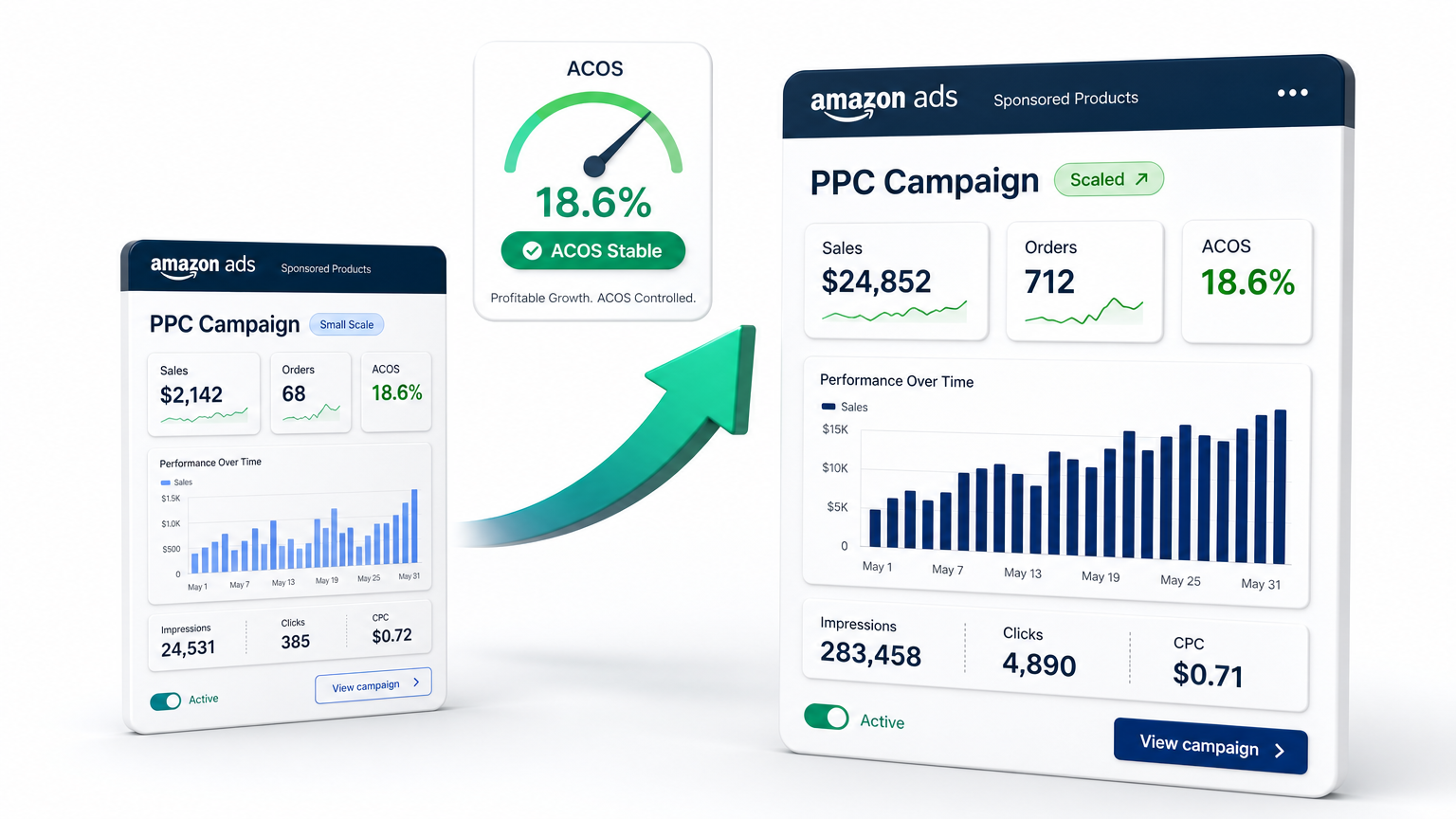
If Amazon PPC scaling is giving you more tension than sales, you are not alone. Many Amazon sellers in India push budgets, see a short revenue spike, then watch ACOS explode and margins vanish within a few weeks.
The problem rarely lies in your “ambition to scale”. It lies in scaling without a clear set of rules for ACOS, bids, budgets and overall ad spend. This guide breaks down a practical framework you can use in 2026 to grow revenue steadily, without burning profit.
Start With Numbers: Break-Even ACOS, Target ACOS And TACOS
Before touching bids or budgets, you need three guardrails: break-even ACOS, target ACOS and target TACOS. Without these, every scaling decision is guesswork and any growth is hard to repeat.
Break-even ACOS tells you the maximum advertising cost you can afford before you lose money on a sale, and is the baseline for Amazon ACOS optimization. Once that is clear, you can pick a realistic target ACOS that still leaves room for profit and set a TACOS range that keeps overall catalogue margins healthy.
If you want step-by-step formulas and examples, start with the detailed guide on how to calculate your break-even ACOS and pair it with the comparison of ACOS vs TACOS to understand how both fit into your scaling plan.
Build A Scale-Ready Campaign Structure
Messy campaign structure is one of the biggest reasons Amazon PPC optimization fails when you try to scale. If all your keywords sit in a couple of auto or broad campaigns, pushing budget simply makes Amazon spend more on the same mixed bag of queries.
For stable scaling, separate campaigns by intent and role: launch, scale, defence, conquest, harvesting and recovery. This kind of “bucketed” structure lets you increase budgets on winning pockets while keeping experimental and defensive spend under control.
There is a full breakdown of this approach in the article on the 6-bucket campaign structure top sellers use, which is a strong base for long-term Amazon PPC management.
Control Bids First, Then Budgets
Most sellers in India scale in the wrong order: they increase budgets first and only tweak bids after ACOS goes bad. That is backwards. If your bids are too high, extra budget only buys extra waste.
Start by deciding your acceptable cost per click from your target ACOS and conversion rate. Then tighten bids down on poor performers and raise them slightly on proven keywords. This is the core of any solid Amazon bid optimization strategy.
Once your bids are aligned, you can raise daily budgets on profitable campaigns in small steps and watch how ACOS and ROAS react over a few days before making another move. If you are unsure about the right calculation, the walkthrough in the exact formula for your target CPC is a practical companion.
Amazon PPC Scaling Rules For Bids
- Cut bids on keywords with high spend and no sales over a meaningful number of clicks.
- Lower bids slowly on borderline ACOS terms instead of pausing them instantly.
- Increase bids only on keywords that are already profitable and constrained by low impressions.
- Always compare Sponsored Products data by placement before flooding top-of-search with higher bids.
Protect TACOS As You Scale Top Products
Scaling a single hero ASIN can easily drag up overall ad spend and destroy TACOS if you are not watching the full picture. Sellers often celebrate great ROAS on one campaign while catalogue-wide profit silently shrinks.
To keep TACOS in check, monitor the share of revenue driven by ads versus organic for each group of products. As you pour more budget into Sponsored Products, track whether organic sessions and sales are rising at a similar pace.
The guide on ACOS vs TACOS vs ROAS goes deep into how these metrics move together. Use it to select realistic TACOS bands for your brand stage before making aggressive Amazon ROAS targets.
Eliminate Waste: Search Terms, Negatives And Dayparting
Scaling before cutting waste is like filling a leaking bucket. Every rupee you add flows out faster. Cleaning up search terms is usually the fastest way to improve Amazon advertising cost before you increase budgets.
Start by mining auto and broad campaigns for search terms with high spend and zero sales. Move good performers into focused manual campaigns and add the bad queries as negatives. This keeps future spend on the right side and aligns with long-term Amazon PPC strategy.
For a repeatable workflow, use the article on keyword harvesting for Amazon PPC together with the guide to negative keywords. Once your terms are clean, you can look at dayparting by time of day to cut low-converting hours before you scale budgets.
Use Dayparting Before Big Budget Jumps
In India, many categories see weaker conversion late at night and in some afternoon hours. If your ads keep running at full strength during those windows, scaling will exaggerate the waste.
By applying dayparting rules first, you concentrate your higher scaled budgets into the hours with the strongest conversion behaviour. That alone often improves Amazon TACOS trends before any fresh campaign build.
Scale By Ad Type: Sponsored Products First
When you are ready to go beyond basic scaling, think about which ad types carry the most reliable performance for your products. For most brands, Sponsored Products should take the lead because they are closest to the purchase decision and easier to read in ACOS terms.
Once Sponsored Products are stable, you can use Sponsored Brands and Sponsored Display to expand reach, defend your brand and support your Amazon PPC budget at a category level. This staged approach helps avoid wild swings in performance when you introduce new formats.
If you want a clear comparison of how each ad type behaves, the guide on Sponsored Products vs Sponsored Brands vs Sponsored Display is a useful reference before you make large ad type shifts.
Amazon PPC Scaling For Sponsored Products
As you scale Sponsored Products, break out branded and non-branded campaigns separately so you can control bids and budgets more accurately. Branded terms usually have lower ACOS and stronger click-through, so you can afford slightly higher bids there.
Non-branded terms are where most of your Amazon PPC scaling potential lies, but they are also where overspending happens fastest. The article on branded vs non-branded campaigns offers a simple structure to do this cleanly.
Use Live Data And Automation, Not Gut Feel
As Amazon ad auctions get more competitive in 2026, manual check-ins once or twice a week are no longer enough. You need near real-time data on spending spikes, placement shifts and ACOS swings if you want to scale confidently.
That is where tools that consume Amazon Marketing Stream events and apply rule-based or AI-driven bid changes can make a real difference. Instead of reacting late, you are adjusting bids and budgets as performance changes.
The article on Amazon Marketing Stream integration explains how this kind of data feed works, while the broader piece on how AI is changing Amazon advertising shows how advanced brands are already managing Amazon PPC costs at scale.
India-Specific Checks Before Scaling Hard
Scaling on Amazon from India often involves extra moving parts: GST-inclusive pricing, regional demand spikes during festive months and logistics constraints during sale periods. All of these affect how aggressively you should push your ads.
Before you double down on budgets, check that your inventory, fulfilment and pricing can absorb a sustained increase in sales. If stockouts or delayed deliveries rise, your Amazon PPC optimization work will not pay off because rankings and reviews will suffer.
For brands planning to go from modest to more serious scale, the article on how to scale your Amazon brand lays out a wider roadmap that sits around your campaigns.
Conclusion
Scaling Amazon ads profitably in 2026 is less about one secret tactic and more about a consistent process: know your break-even ACOS, control bids before budgets, cut waste, and then expand thoughtfully by ad type and time of day. Done right, Amazon PPC scaling can grow both revenue and profit for brands selling from India.
If you want to move faster with fewer mistakes, pairing disciplined execution with smarter automation, such as that described by Insta Track Pro on its home page, can help you apply these principles to your account step by step.
Frequently Asked Questions
Q1. How should I decide a safe budget for Amazon PPC scaling in 2026?
Ans: Start by calculating your break-even ACOS and target ACOS, then work backwards to a monthly budget you can afford to risk. Treat your first scaling phase as a controlled test, and increase budgets only on campaigns that consistently hit your Amazon advertising cost goals over several weeks.
Q2. What is a good TACOS range for Amazon sellers in India?
Ans: There is no single “good” TACOS number because it depends on your margins, category and growth stage. Many brands begin with a higher TACOS during launch and then tighten it as organic sales grow. The key is to track TACOS alongside ACOS so your overall Amazon TACOS trend stays stable while you scale.
Q3. How do I improve Amazon ROAS without cutting all my important keywords?
Ans: Instead of hard pausing, start by lowering bids on borderline terms and adding negatives for irrelevant queries. Then move your best search terms into tightly themed campaigns where you can give them focused budget. This approach improves Amazon ROAS by shifting spend, not shrinking your entire keyword set.
Q4. Which campaigns should I scale first in my Amazon PPC strategy?
Ans: Prioritise campaigns with stable sales, acceptable ACOS and enough impression share to grow. For most sellers, this means scaling Sponsored Products campaigns that already convert well, then slowly expanding into Sponsored Brands and Sponsored Display once your main revenue-driving ads are under control.
Q5. How often should I adjust bids for effective Amazon PPC management?
Ans: The right frequency depends on your ad volume, but many sellers review bids at least a few times each week during active scaling phases. Instead of making large, erratic changes, apply smaller, rule-based adjustments informed by your Amazon bid optimization data so performance stays stable while you grow.
Q6. Can I scale Amazon Sponsored Products only, or must I use all ad types?
Ans: You can build a strong base using only Sponsored Products if you structure campaigns well and keep up regular Amazon PPC optimization. Over time, introducing Sponsored Brands or Sponsored Display helps expand reach and protect your brand, but they should support, not replace, your best-performing Sponsored Products campaigns.
Leave a Reply